RaiderChip presents Kairós, the prototype of its first Generative AI inference ASIC, at OCP EMEA 2026
The live demo enables intelligent agents running locally, thanks to its ability to execute multiple models simultaneously and its support for context windows of up to 64,000 tokens.
Barcelona, May 7th, 2026
RaiderChip participated in the latest edition of OCP EMEA 2026, where it publicly unveiled the prototype of Kairós, its local Generative AI acceleration platform, based on RaiderChip’s custom NPU hardware architecture and designed to boost inference efficiency. During the event, attendees were able to interact directly with the prototype in real time, experiencing first-hand its performance and versatility.
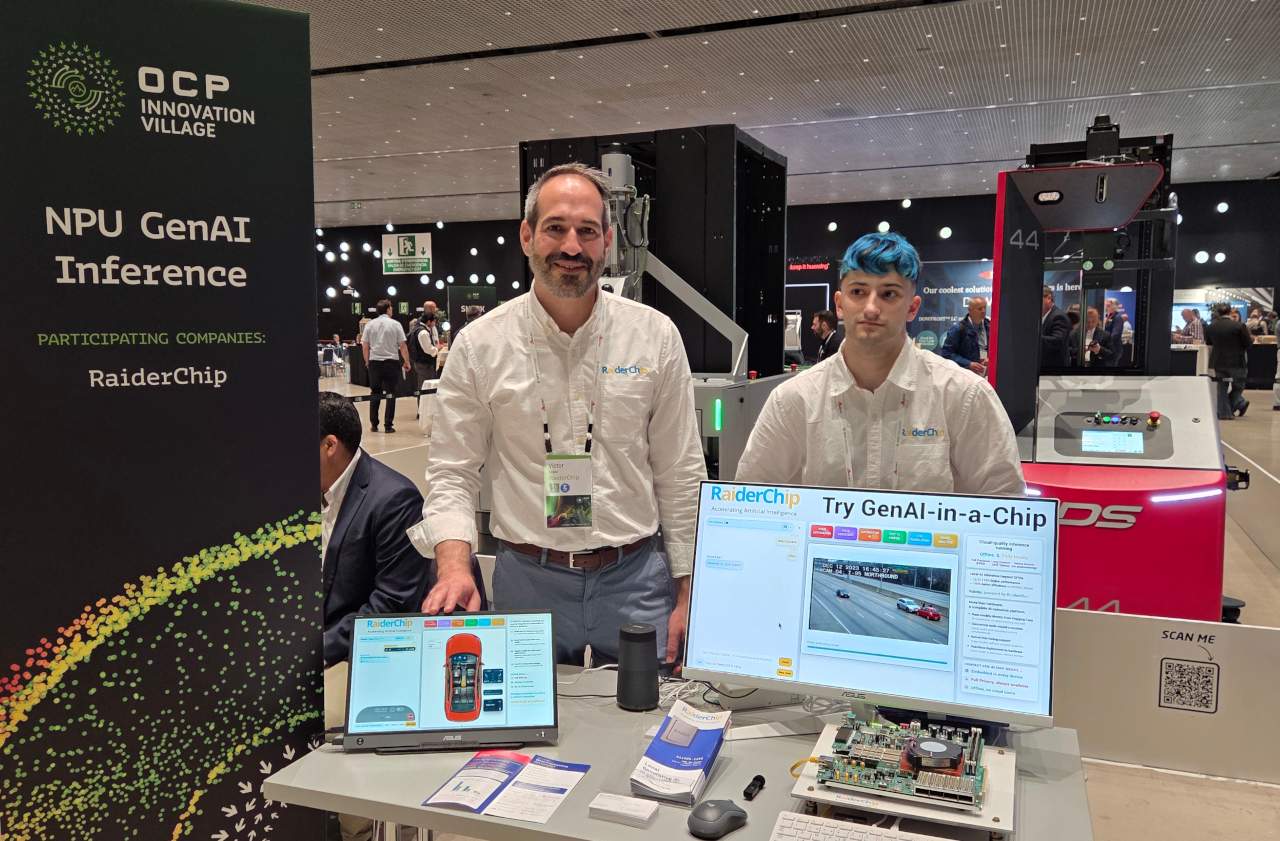
RaiderChip's live demo of the Kairós prototype at the OCP Innovation Village, OCP EMEA 2026
The Kairós AI accelerator can execute more than 20 multimodal Generative AI models from leading companies in the sector, including Meta, Alibaba, OpenAI, Microsoft, Google, DeepSeek and Mistral, without preprocessing, both individually and simultaneously.
The simultaneous execution of models specialized in different cognitive functions enables the creation of agents capable of combining perception, reasoning and action in real time: they listen, interpret, analyze images, respond, and can execute tasks directly on external systems, such as controlling devices via APIs.
Thanks to RaiderChip’s orchestration layer—responsible for coordinating model loading, execution and model parallelism on Kairós—and its dedicated architecture, which combines structured multiplexing, deterministic scheduling and highly efficient use of memory bandwidth, Kairós is able to sustain over 90% utilization of its compute units, exceeding the utilization levels commonly achieved in conventional AI accelerators. This combination enables Kairós to power multimodal intelligent agents on a compact, local platform, with up to a 2.4x better Energy Delay Product compared to traditional GPU-based platforms.
However, the development of intelligent agents capable of performing real-world functions will depend not only on the efficient and concurrent execution of base generative models, but also on the ability to specialize and contextualize them for specific tasks.
To address this, Kairós has been designed from the ground up to natively run post-trained and fine-tuned models, adapted by users to specific domains or functions, while it also leverages its 64,000-token context window to load operational instructions, behavioral rules, environmental information, working memory and long conversations, guiding agent behavior without requiring modifications to the base model.
“Our goal is for Generative AI to become a natural component of every vehicle, machine, industrial system or device, not only in the cloud, but also at the edge, directly within the target devices. That is why we have designed Kairós: a compact, low-power and portable NPU intended to bring intelligence directly to where it is needed, without reliance on cloud infrastructure or even on network connectivity,” said RaiderChip’s CTO.
RaiderChip’s participation in OCP EMEA reinforces its position as an OCP Startup Member and as a European developer of semiconductor hardware for Generative AI acceleration, with a proprietary architecture designed to address the key challenges of this new computing paradigm: inference efficiency, memory bandwidth utilization, power consumption and scalable local deployment.
WANT TO KNOW MORE?
Watch the demo and learn more about RaiderChip Kairós
Actividad del proyecto KAIROS V1, subvencionado por el CDTI y apoyado por el Ministerio de Ciencia, Innovación y Universidades (NEOTEC 2025).